

Sweden showcases its district energy leadership at Euroheat & Power Congress
The Swedish Energy Agency brought a delegation to the Euroheat & Power Congress, where Europe’s leading voices and innovators gathered for three days of exchange, insights, and networking.

The session on low‑temperature systems attracted 125 attendees. Photo: Euroheat & Power
Euroheat & Power Congress is Europe’s largest district heating and cooling forum. This year, the annual flagship event convened in Krakow, Poland against the backdrop of the recent energy crisis, rising energy costs, and a renewed focus on energy security among decision‑makers. The Swedish Energy Agency, in collaboration with the Sustainable Heating & Cooling by Sweden (SHC) platform, Business Sweden, and Swedenergy, joined forces to bring a strong Swedish representation to the event.
Heating and cooling accounts for half of Europe’s energy use, a fourth of its CO2 emissions and a significant share of its fossil imports. As a result, scaling up clean district energy has become a strategic lever for a secure, decarbonised, and competitive Europe. Sweden is uniquely positioned to lead the way in this transition. The central message at the congress was to highlight Sweden’s experience, partnerships and scalable technologies that can support the next phase of Europe’s heating and cooling systems.
The Swedish Energy Agency hosted a well-attended session on Low-Temperature district heating and cooling, bringing together perspectives from across the value chain, including utilities, technology providers and policy experts. The session explored how utilities and technology providers are being challenged and reshaped in how they generate and distribute heat and how low-temperature systems can act as catalysts to unlock new economic value, business model innovation, and competitiveness.
“Sweden has demonstrated that large-scale decarbonisation of heating is achievable. The next frontier is the shift to low‑temperature systems where optimisation, flexibility, and the integration of waste and renewable heat sources become key enablers in unlocking greater efficiency, long‑term value, system resilience, and energy security”, says Sofie Fjellgren, Business Developer at the Swedish Energy Agency.
Sweden is widely recognized as a leading example in the transition to fossil-free heating and cooling, with around 98 percent of district heating based on renewable or recovered energy. Today, the system is entering a new stage of development - rather than focusing on fuel switching, attention is increasingly directed towards how heat is generated, distributed and integrated within a wider energy system.
“What stood out throughout the congress was the growing focus on integrated energy systems. Across Europe, district heating is increasingly being recognised not only as a way to decarbonise heating, but also as a flexible and controllable resource that can support electrification, improve system efficiency and strengthen energy resilience,” says Sezgin Kadir, CEO and Group President of Kraftringen and Chairman of Swedenergy.
The Swedish delegation at the Euroheat & Power Congress, also had a hub on the exhibition floor, where Liqway, Wioniq, AKJ Energiteknik, Noda Intelligent Systems, Energy Opticon, KLAB, Kraftringen, Alfa Laval, SWEP and Carboseal showcased Swedish innovations across the value chain; from digital optimisation and system integration to components and large-scale industrial solutions.
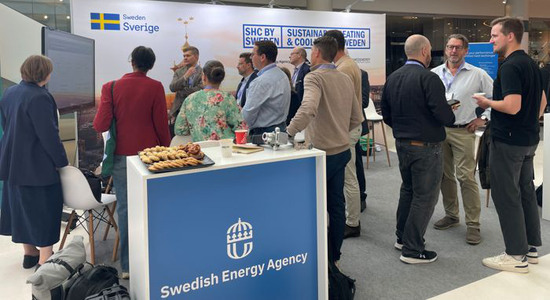
The Swedish delegation’s hub at the Euroheat & Congress exhibition floor. Photo: Swedish Energy Agency
At the hub, the Sustainable Heating & Cooling by Sweden (SHC) platform arranged a dedicated exchange with PGE Polska Grupa Energetyczna (PGE), one of Poland’s largest energy companies and a key player in the country’s district heating and power sector. The session gave the Swedish representatives insights into PGE’s ongoing transition strategy and long-term decarbonisation plans. It also provided an opportunity for the Swedish companies to engage in concrete business dialogues with PGE, and to explore potential partnerships linked to its ongoing decarbonisation efforts.
The delegates also had the opportunity to connect these discussions with real-world implementation through a technical site visit to the Kraków CHP plant, operated by PGE Energia Ciepła. The facility supplies more than 70 percent of the city’s district heating and is currently undergoing a phased transition away from coal, with planned investments in heat pumps, biomass, storage and electrification. The visit illustrated how large-scale systems can evolve step by step while maintaining security of supply.
“A recurring theme during the congress was that there is no single pathway for the future of district heating. The most successful solutions are built on local conditions, whether that means industrial excess heat, access to sustainable fuels, thermal storage or industrial symbiosis. District heating creates value when it can connect and optimise local resource flows within a broader energy system” says Sezgin Kadir.
By convening public actors, utilities, research institutions, and innovative companies in one, coordinated presence, the Swedish delegation was able to demonstrate not only individual technologies but a system approach – elevating its visibility at the congress.
“By acting together and showcasing the scale of our district energy ecosystem, we can reinforce the strategic conditions for Swedish companies to shape, contribute to, and benefit from Europe’s accelerating energy transition agenda - and expand their role as competitive, trusted partners in international markets, Sofie Fjellgren concludes.
The next Euroheat & Power Congress will take place on 8 - 10 June 2027 in Marseille, France.


