

Article 6 of the Paris Agreement
Article 6 of the Paris Agreement regulates mechanisms for cooperation between countries and global trading with emissions.
Under the Paris Agreement, ratifying countries have committed to reduce their greenhouse gas emissions. All countries must express the highest possible ambition in their respective nationally determined contributions (NDCs). However, there are significant differences between countries when it comes to the conditions for reducing emissions.
The goal of Article 6 of the Paris Agreement is to enable cooperation between countries so that they can achieve their respective NDCs and contribute to increased global climate ambition. Through bilateral and multilateral partnerships, it is possible to achieve greater emission reductions than would be feasible using only a country’s own resources and domestic measures.
The Swedish Energy Agency has been mandated by the Swedish government to enter into cooperation agreements with other countries on Sweden’s behalf in accordance with Article 6 of the Paris Agreement.
International emissions trading
Emission reductions generated through international climate cooperation activities can be transferred between countries through international emissions trading. Countries that trade emission reduction units must account for these transactions in their climate reporting to the United Nations by adjusting their emissions balance to reflect units sold or purchased. This adjustment is essential to ensure double counting of emission reductions does not happen.
Cooperation under Article 6 requires that; participating countries engage voluntarily and benefit from the partnership; the cooperation contributes to global emission reductions; and that it supports increased climate ambition.
Increased climate ambition
Increased climate ambition is essential if the goals of the Paris Agreement are to be achieved, namely limiting the increase in global temperature to well below 2°C while aiming for 1.5°C. Current levels of ambition are estimated to place the world on a pathway towards approximately 3°C of warming.
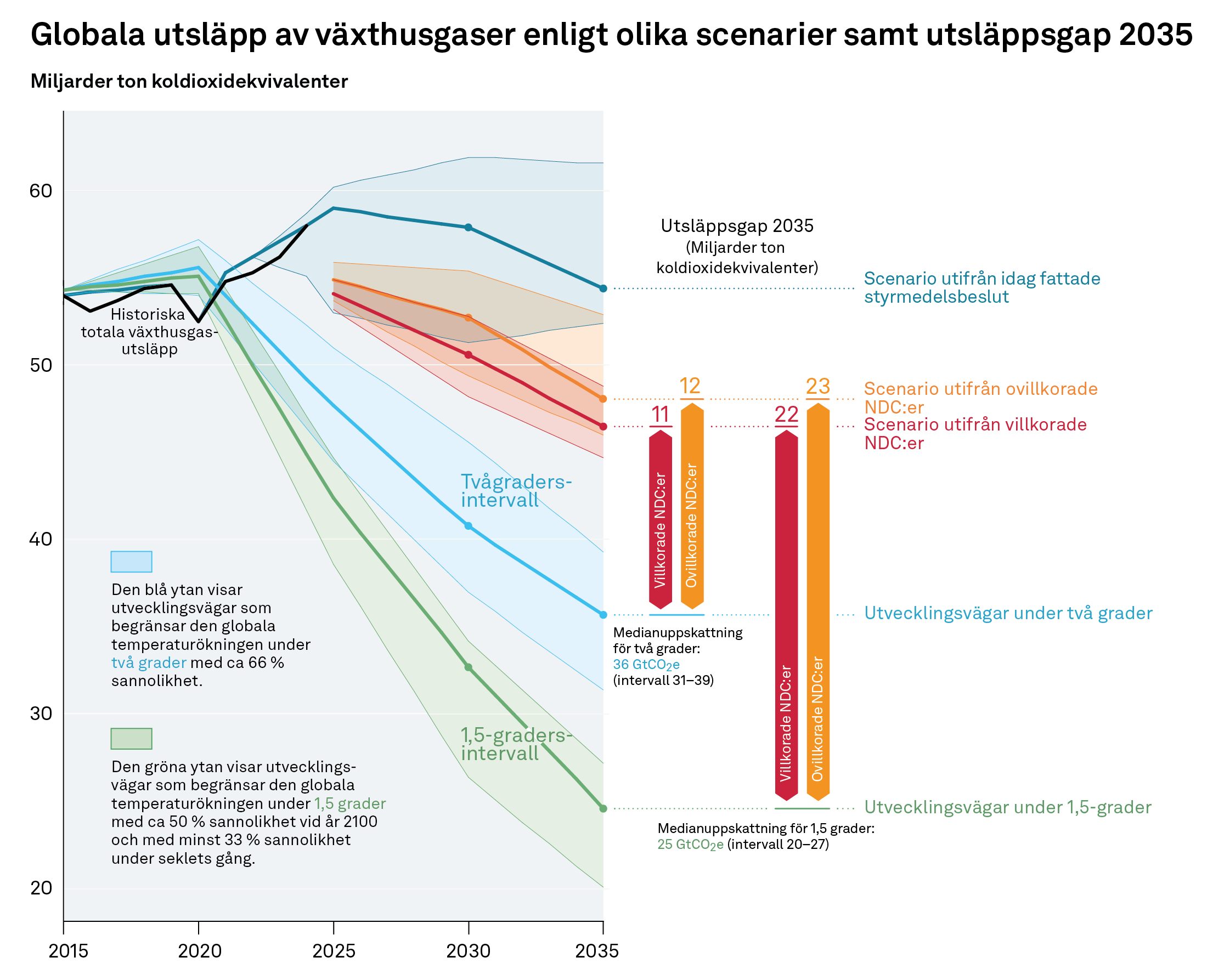
Click on the image to enlarge it. Figure: Adapted from the UNEP Emissions Gap Report 2025. Significant emission reductions are required to achieve both the 2°C and 1.5°C targets. The figure illustrates that current national commitments are insufficient to meet either goal.
Article 6 cooperation is cost-effective
Cooperation under Article 6 provides an opportunity to reduce emissions cost-effectively where the greatest impact can be achieved. A well-functioning market for emission reductions under Article 6 of the Paris Agreement could enable countries around the world to meet their climate targets at a substantially lower cost. If countries reinvest these savings in additional climate action, Article 6 trading has the potential to deliver significantly greater global emission reductions.
Supporting the green transition and sustainable development
In addition to reducing greenhouse gas emissions, cooperation under Article 6 can support sustainable development, capacity building, and the dissemination of climate-friendly technologies. This can, in turn, contribute to a faster energy transition and climate transition across a greater number of countries.


